
Atomic Force Microscopy (AFM)
Atomic Force Microscopy (AFM) is a high-resolution imaging and characterization technique that operates by scanning a sharp probe (cantilever) across a sample surface. The probe interacts with the sample through atomic forces, including van der Waals, electrostatic, and mechanical contact forces. As the cantilever moves, its deflection is measured using a laser beam and photodetector system, generating a three-dimensional (3D) topographic map with nanometer-scale resolution. Unlike electron microscopy, AFM does not require vacuum conditions or conductive coatings, making it ideal for analyzing soft, delicate, or insulating materials such as pharmaceutical particles, polymers, and biological samples. AFM can operate in multiple modes, including contact mode, tapping mode, and non-contact mode, allowing for versatile applications in material science and life sciences.
Applications in Pharmaceutical Partical Analysis
In pharmaceutical development, AFM plays a critical role in characterizing drug particles at the nanoscale. It provides detailed insights into particle size, shape, surface roughness, and mechanical properties, which are essential for optimizing drug formulations. For example, AFM can assess the crystallinity of active pharmaceutical ingredients (APIs), detect amorphous content, and evaluate coating uniformity in controlled-release formulations. Additionally, AFM enables the study of drug-excipient interactions, helping to predict stability and dissolution behavior. In biopharmaceuticals, AFM can analyze protein aggregates, liposomes, and nanoparticles, ensuring their structural integrity and functionality. By offering high-resolution, real-time, and label-free imaging, AFM supports drug development from early-stage research to quality control (QC) in manufacturing.
AFM offers several key advantages over traditional microscopy techniques. First, it provides true 3D topography with sub-nanometer resolution, surpassing the capabilities of optical microscopy and even some scanning electron microscopy (SEM) methods. Unlike SEM, AFM does not require sample coating or vacuum conditions, preserving the native state of drug particles and biological samples. Second, AFM can measure mechanical properties, such as stiffness, adhesion, and elasticity, which are crucial for understanding drug delivery systems (e.g., microneedles, hydrogels). Third, AFM operates in liquid environments, allowing real-time observation of drug dissolution, particle aggregation, and interactions with biological membranes. Finally, AFM is compatible with a wide range of samples, from dry powders to hydrated biological specimens, making it a versatile tool for both small-molecule and biologic drug development.
PharmaAnalytica's Technology Platform
ABN-AFM-001 AFM
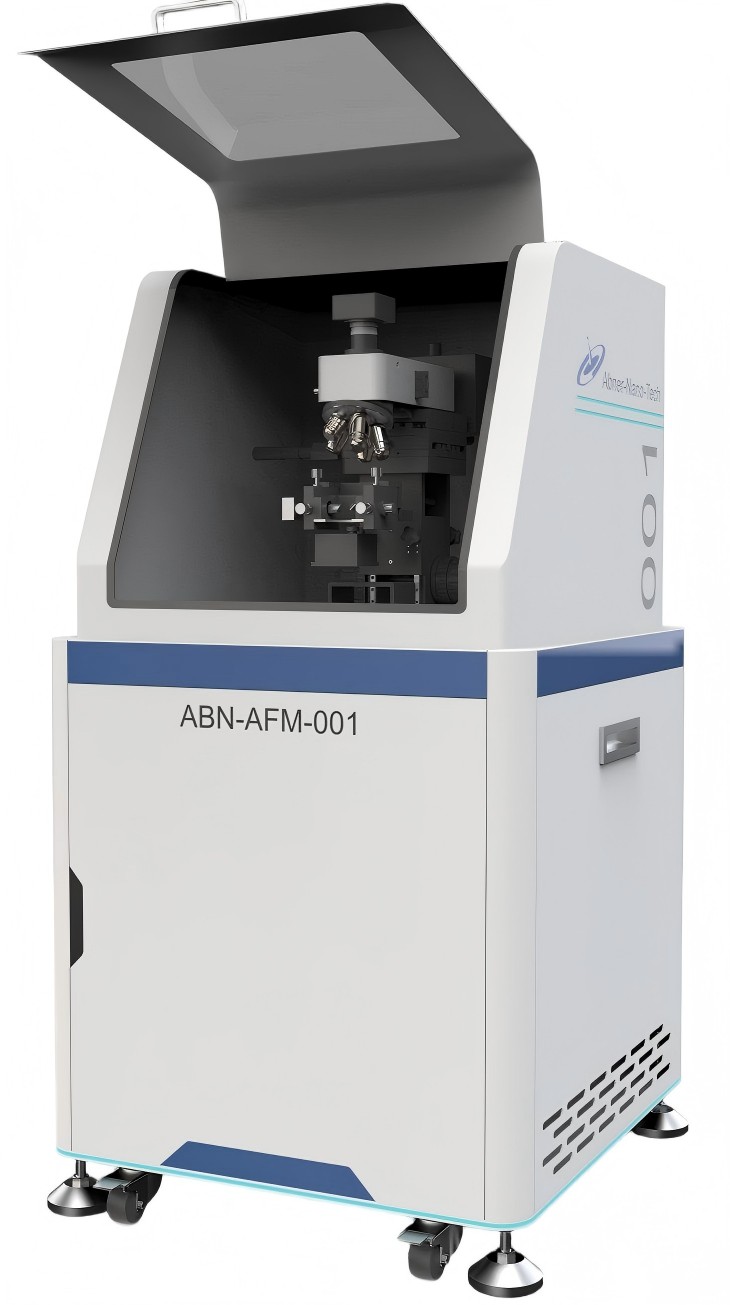
ABN-AFM-001 AFM operates in contact and tapping modes, accommodating solids, liquids, and thin films. Its 3D imaging reveals detailed surface topography and microstructures.
AtomEdge Pro AFM
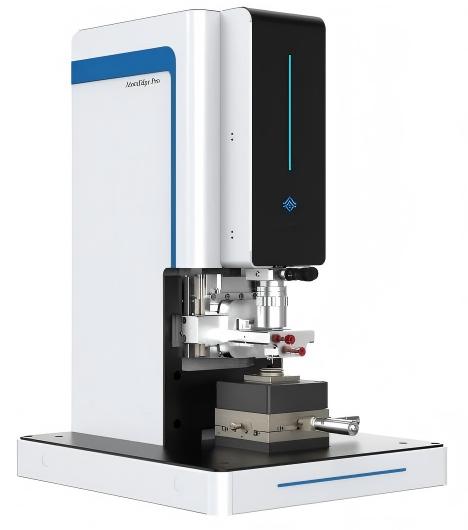
AtomEdge Pro supports contact, tapping, and non-contact modes, enabling sub-nanometer 3D scanning imaging and characterization. Integrated functional modes such as MFM, EFM, SKPM, and PFM provide tailored solutions for specialized research fields and enhance comprehensive material analysis at the nanoscale.
PharmaAnalytica's AFM-Based Particle Analysis
PharmaAnalytica's AFM services empower pharmaceutical researchers with high-resolution, label-free, and quantitative analysis of drug particles, enabling better formulation design and quality assurance.

High-Resolution and Quantitative Analysis
PharmaAnalytica's AFM services deliver nanometer-scale imaging and quantitative data on particle size, surface roughness, and mechanical properties. Our advanced AFM systems ensure precise measurements, supporting formulation optimization and regulatory submissions.

Customized Experimental Design
We tailor AFM testing protocols to meet specific project needs, whether for solid dosage forms, nanoparticles, or biologics. Our team collaborates with clients to design experiments that address critical challenges in drug stability, dissolution, and delivery.
Fast Turnaround and Reliable Data
With streamlined workflows and experienced analysts, PharmaAnalytica provides rapid and reproducible results, accelerating R&D timelines. Our data reports include detailed statistical analysis, ensuring reliability for QC and regulatory compliance.
Multi-Technique Integration
Beyond AFM, PharmaAnalytica integrates SEM, Raman spectroscopy, and DSC for comprehensive material characterization. This multi-modal approach enhances understanding of drug formulations and supports robust scientific decision-making.
By leveraging AFM's unique capabilities—such as 3D nanoscale imaging, mechanical property mapping, and liquid-phase studies—we provide critical insights that drive innovation in drug development. Whether for small-molecule APIs, biologics, or advanced drug delivery systems, PharmaAnalytica's expertise ensures accurate, efficient, and actionable data for the pharmaceutical industry.
Online Inquiry
This site is protected by reCAPTCHA and the Google Privacy Policy and Terms of Service apply.
Need More Information or Request A Quotation?
Related Links
