
Microcrystal Electron Diffraction (MicroED)
Microcrystal Electron Diffraction (MicroED) is an emerging structural biology technique that leverages cryo-electron microscopy (cryo-EM) to determine atomic-resolution structures of small molecules, peptides, and proteins from nanocrystals (typically <1 µm in size). Unlike traditional X-ray crystallography, which requires large, well-ordered crystals, MicroED uses a transmission electron microscope (TEM) to analyze electron diffraction patterns from microcrystals embedded in vitreous ice. Electrons interact more strongly with matter than X-rays, enabling high-resolution data collection from extremely small crystals. By rotating the crystal under the electron beam and collecting diffraction patterns at multiple angles, MicroED can reconstruct 3D atomic structures with resolutions comparable to X-ray crystallography (often <1 Å). This makes it particularly valuable for studying challenging drug targets that are difficult to crystallize conventionally.
Applications in High-Throughput Screening (HTS)
In the Hit-to-Lead (H2L) phase of drug discovery, rapid structural determination of drug-target interactions is critical for optimizing compound potency, selectivity, and binding modes. MicroED accelerates this process by enabling:
- Structure-based hit validation: Confirming binding poses of fragment-sized molecules or weak hits that would otherwise require extensive crystallization efforts.
- Membrane protein drug targeting: Resolving structures of GPCRs, ion channels, and other membrane-bound proteins that are notoriously difficult to crystallize for X-ray analysis.
- Covalent inhibitor characterization: Visualizing covalent modifications between drug candidates and target proteins at atomic resolution.
- Polymorph screening: Identifying different crystalline forms of small-molecule drugs to optimize bioavailability and stability.
By providing structural insights earlier in the pipeline, MicroED reduces the need for iterative synthesis and crystallization trials, shortening the timeline from hit identification to lead optimization.
MicroED offers several key advantages over traditional X-ray crystallography and cryo-EM single-particle analysis. First, it eliminates the need for large, high-quality crystals, as even poorly diffracting microcrystals can yield high-resolution data. This is particularly beneficial for challenging targets like membrane proteins or flexible peptides. Second, MicroED requires minimal sample preparation—crystals are flash-frozen in vitreous ice without additional handling, preserving their native state. Third, the technique is highly sensitive, capable of detecting weak electron densities from low-affinity ligands or transient binding events. Additionally, MicroED is compatible with a wide range of compounds, including insoluble or metastable molecules that are difficult to study with other methods. Finally, data collection is rapid (often completed in minutes per crystal), making it suitable for high-throughput screening campaigns. These advantages position MicroED as a transformative tool for structural biology and drug discovery.
PharmaAnalytica's Technology Platform
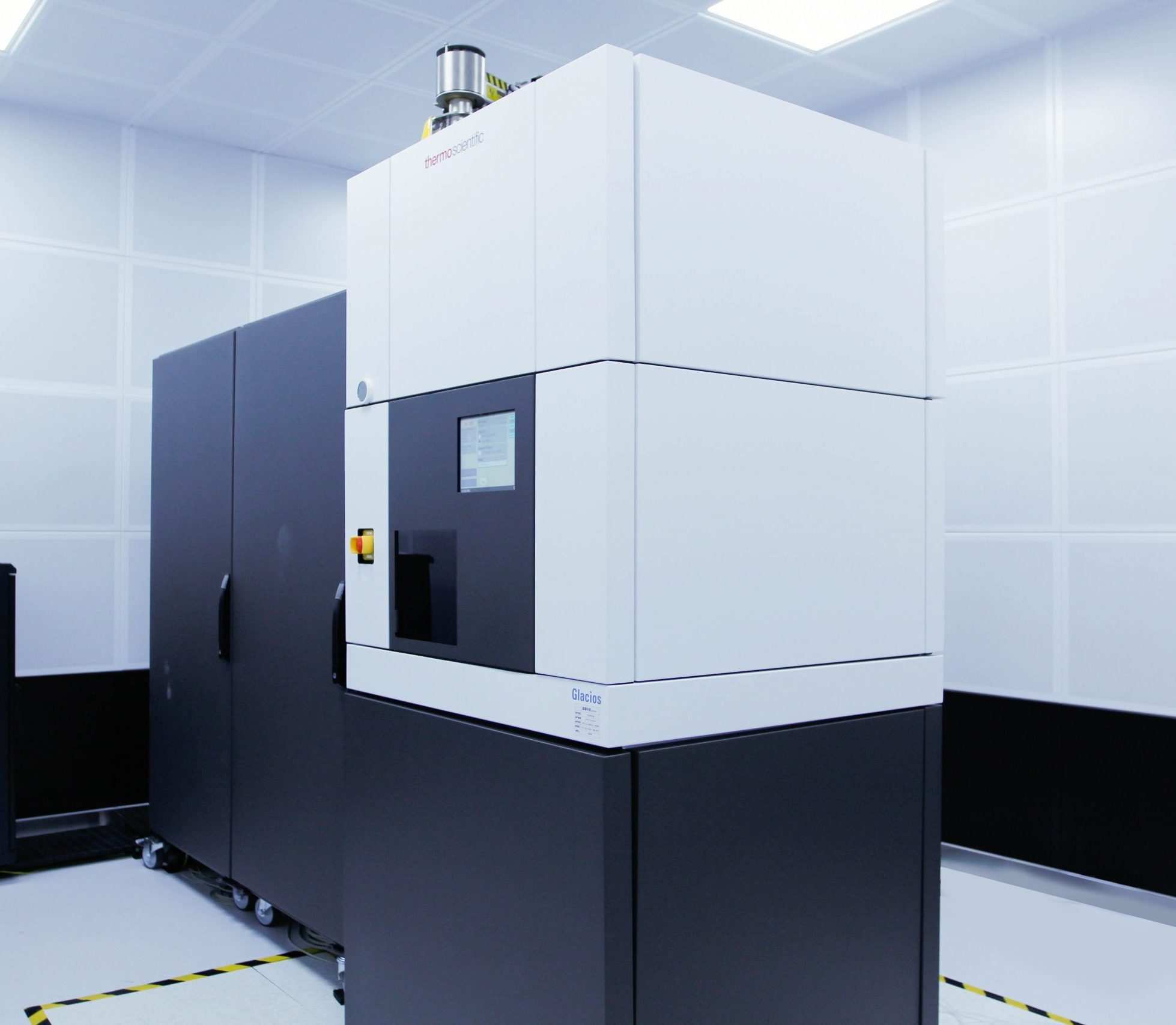
The fully automated MicroED platform revolutionizes hit screening in drug discovery by enabling high-precision crystal structure determination in as little as 1 day—without single-crystal growth, using only milligram quantities of powdered samples, dramatically accelerating early-stage lead optimization.
PharmaAnalytica's HIT Screening Services with MicroED
PharmaAnalytica's MicroED service bridges a critical gap in early-stage drug discovery by enabling atomic-resolution structural analysis of microcrystals that are incompatible with conventional methods.

High-Resolution Structural Determination
PharmaAnalytica's MicroED platform achieves resolutions down to 0.8 Å, enabling precise mapping of drug-target interactions, hydrogen bonding networks, and ligand conformations. This level of detail is critical for rational drug design, particularly in optimizing fragment-sized hits.

Expertise in Challenging Targets
Our team specializes in structurally complex systems, including membrane proteins, protein-protein interfaces, and flexible peptides, which are often inaccessible via X-ray crystallography. We employ advanced sample preparation and data processing techniques to maximize success rates.
Rapid Turnaround Time
From sample submission to structure delivery, STEMart provides results within 4 weeks, significantly faster than traditional crystallography. This speed is invaluable for iterative drug optimization cycles.
Integrated Drug Discovery Support
Beyond structure determination, we offer complementary services such as molecular docking, binding affinity analysis, and polymorph screening, providing a comprehensive solution for hit-to-lead progression.
By combining speed, sensitivity, and expertise in challenging targets, we empower pharmaceutical and biotech researchers to accelerate hit validation and lead optimization with confidence.
Online Inquiry
This site is protected by reCAPTCHA and the Google Privacy Policy and Terms of Service apply.
Need More Information or Request A Quotation?
Related Links
