
Flow Imaging Microscopy (FIM)
Particulate matter in Active Pharmaceutical Ingredients (APIs) and excipients—including subvisible particles, aggregates, foreign contaminants and micro-scale particulates—directly impacts drug solubility, bioavailability, formulation stability and clinical safety. As the gold-standard technology for visual particle characterization, Flow Imaging Microscopy (FIM) breaks through the limitations of traditional particle analysis methods (e.g., light obscuration) by realizing real-time imaging, quantitative counting and multi-dimensional morphological analysis of individual particles in liquid dispersion. PharmaAnalytica builds a professional FIM-based Particle Analysis service platform for APIs and excipients, relying on advanced domestic FIM instruments and optimized detection protocols, fully complying with USP <788>/<789>/<1788>, ChP and EP regulatory guidelines, and providing accurate, visual and compliant particle characterization data for pharmaceutical raw material quality control and formulation development.
Core Principle of FIM Technology for Particle Analysis
FIM integrates microfluidic technology, high-resolution digital imaging and AI intelligent analysis algorithms, realizing the seamless combination of flow cytometry's high-throughput advantage and microscopy's visual characterization capability. The core detection process is as follows:
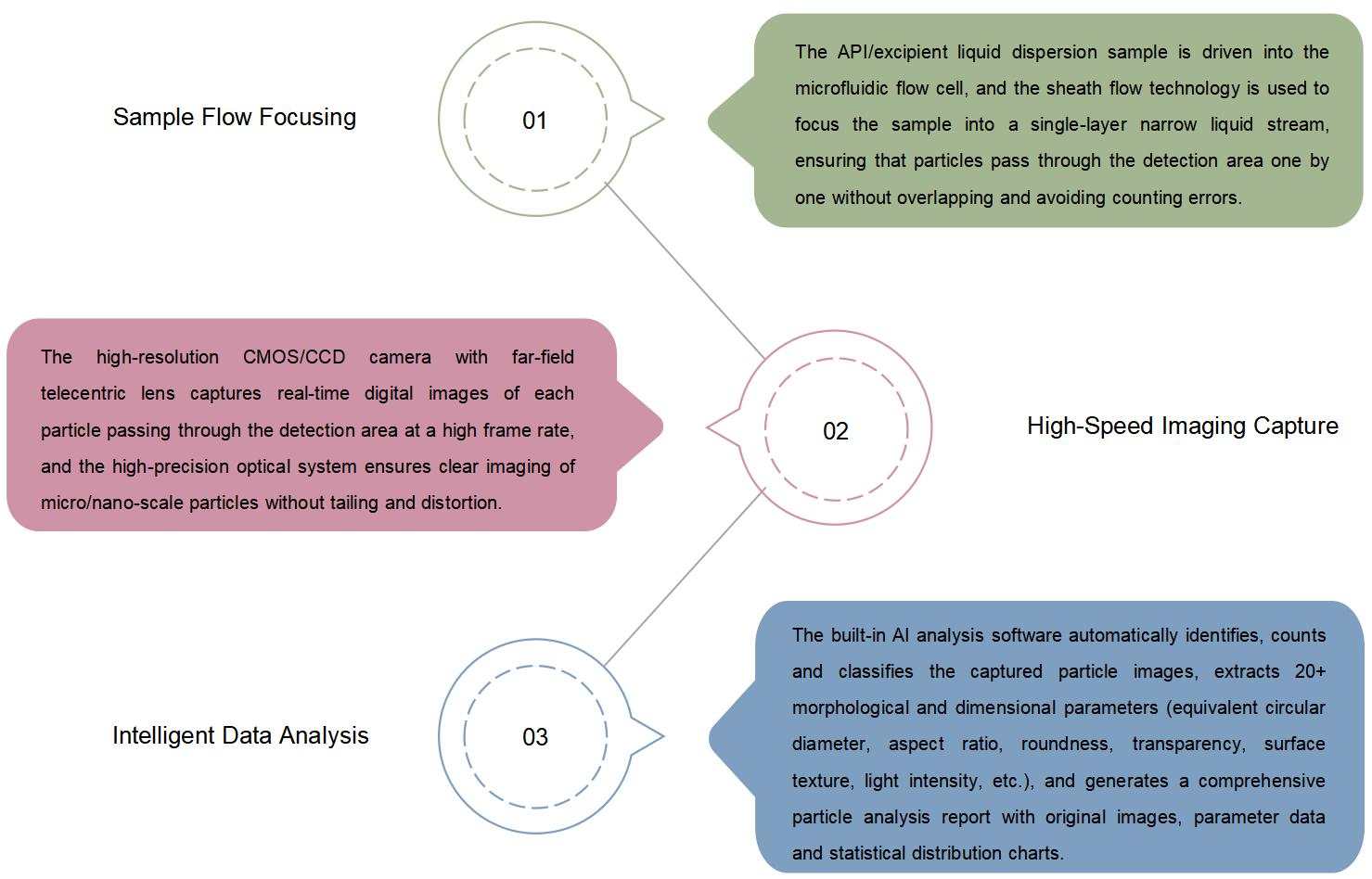
FIM technology realizes the trinity of particle size quantification, morphological identification and concentration statistics in a single detection, and can visually distinguish different types of particles (e.g., crystal aggregates, fibrous contaminants, air bubbles, silicone oil droplets), effectively avoiding false positive/negative results of traditional non-imaging detection methods, and providing direct visual evidence for particle source tracing and risk assessment.
Applications in Pharmaceutical Partical Analysis
PharmaAnalytica's FIM particle analysis service is tailored for the characteristics of pharmaceutical APIs and excipients (powders, liquid dispersions, colloidal systems, etc.), and is widely used in raw material quality inspection, stability research and formulation compatibility evaluation, including the following core application scenarios:
- Subvisible Particle Detection: Quantitative detection of 0.5–100 μm subvisible particles in liquid APIs/excipients (e.g., injectable APIs, polysaccharide excipients), in accordance with USP <788>/<789> limits, and identification of particle types to evaluate raw material purity.
- Aggregation State Evaluation: Visual characterization of crystal aggregation, particle agglomeration and polymorphic transformation in solid APIs (e.g., crystalline small molecule drugs, protein APIs) after dispersion, and analysis of aggregation degree and morphological characteristics to guide raw material pulverization and formulation dispersion process optimization.
- Foreign Contaminant Tracing: Identification of exogenous particulate contaminants (e.g., fibrous impurities, glass particles, metal particles) in APIs/excipients through morphological analysis, and tracing of contamination sources (production equipment, raw material processing, packaging materials) to improve production quality control.
- Stability Research: Continuous detection of particle size and morphology changes of APIs/excipients under accelerated stability test conditions (temperature, humidity, light), evaluation of particle growth, aggregation or precipitation risks, and provision of data support for raw material shelf life determination.
- Formulation Compatibility Verification: Detection of particle changes in API-excipient mixed systems, analysis of whether excipients induce API particle aggregation or precipitation, and screening of excipients with good compatibility to optimize formulation formula.
- Batch Consistency Inspection: High-throughput detection of particle characteristics of different batches of APIs/excipients, statistical analysis of batch-to-batch differences, and ensuring the consistency of raw material quality and particle characteristics.
PharmaAnalytica's Technology Platform
FIPS 10 Flow Dynamic Image Particle Sizer
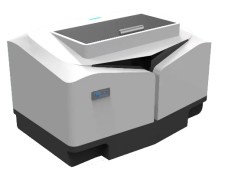
FIPS 10 adopts a high-speed CMOS imaging system, FIPS super-resolution algorithm and AI intelligent algorithm, with a detection particle size range of 0.2–3000 μm, provides simultaneous output of particle morphology and size distribution data, enabling true statistical characterization of particulate matter in pharmaceutical samples.
The instrument and software fully comply with 21 CFR Part 11 and GMP data integrity requirements, supporting audit trails, permission management, electronic signatures and tamper-proof data storage, making it ideal for routine quality control, batch release and stability testing of APIs and excipients in GMP-compliant laboratories.
W-3000 Microflow Imaging Particle Analyzer
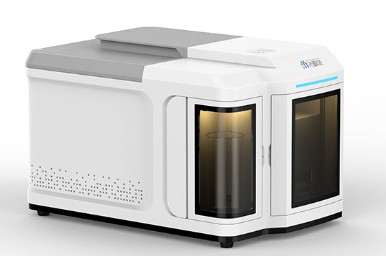
W-3000 employs a high-precision telecentric optical system and stable blue pulse light source, ensuring distortion‑free, high‑clarity imaging for various pharmaceutical particles. It offers a broad detection range of 0.3 μm to 1000 μm, covering subvisible particles, microcrystals, and aggregates in APIs and excipients. Supporting an ultra‑low sample volume of 50 μL, it is perfectly suited for precious early‑stage API samples. Equipped with AI‑driven intelligent particle recognition, it automatically eliminates interference and delivers more than 30 detailed morphological parameters. The system fully complies with GLP data integrity requirements, making it highly reliable for analyzing injectable APIs, colloidal excipients, and subvisible particle testing in pharmaceutical R&D and quality control.
PharmaAnalytica's FIM-Based Particle Analysis

Customized Detection Protocols
According to the physical and chemical characteristics of different APIs/excipients, we customize exclusive detection protocols, and solve the detection difficulties of special raw materials (e.g., high-viscosity excipients, micronized APIs, protein aggregates).

Visual & Multi-Dimensional Analysis
Based on FIM's visual imaging advantage, we not only provide particle size and concentration data, but also conduct analysis of particle morphology, type and distribution, realize accurate tracing of foreign contaminants and aggregation risk evaluation, and provide actionable raw material quality improvement suggestions.
Professional Technical Team
Our team is composed of analytical scientists with rich experience in pharmaceutical particle analysis, who are proficient in FIM technology and pharmacopoeial requirements. We not only provide detection data, but also conduct in-depth interpretation of particle analysis results, combine the characteristics of APIs/excipients to evaluate particle risks, and provide professional technical support for raw material quality control and formulation development.
Regulatory-Ready Data
All detection protocols are validated in accordance with USP <788>/<789>/<1788>, ChP, EP and ICH Q2(R1) guidelines, and the instrument software complies with 21 CFR Part 11 and GMP data integrity requirements. The generated reports include original particle images, complete parameter data and statistical analysis, which can be directly used for drug registration and raw material batch release.
PharmaAnalytica takes advanced dynamic imaging particle analysis technology as the core, and is committed to providing visual, accurate and compliant particle analysis services for pharmaceutical APIs and excipients. We break through the limitations of traditional particle detection methods, turn abstract particle data into visual morphological information, and provide reliable scientific data support for the quality control of pharmaceutical raw materials, helping pharmaceutical enterprises to ensure the safety, stability and compliance of drug products from the source of raw materials.
Online Inquiry
This site is protected by reCAPTCHA and the Google Privacy Policy and Terms of Service apply.
Need More Information or Request A Quotation?
Related Links
